Cacatua galerita Psittaciformes -
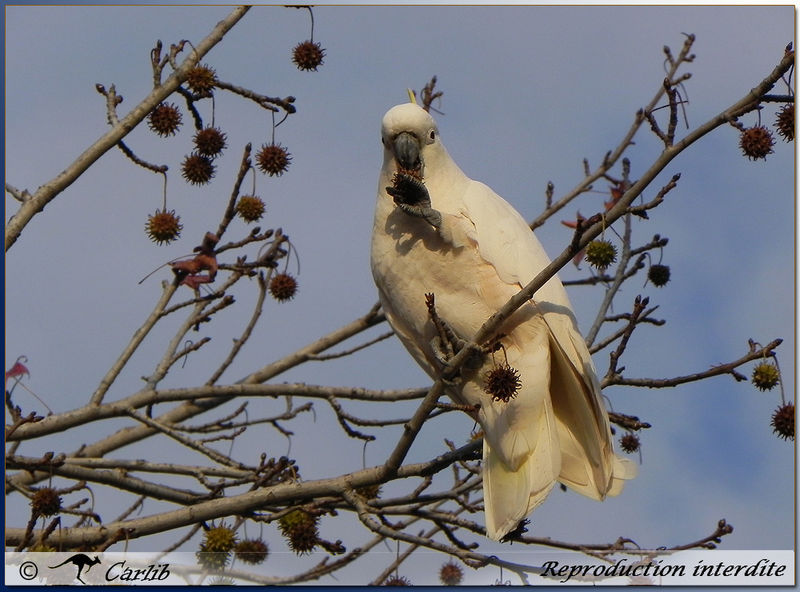
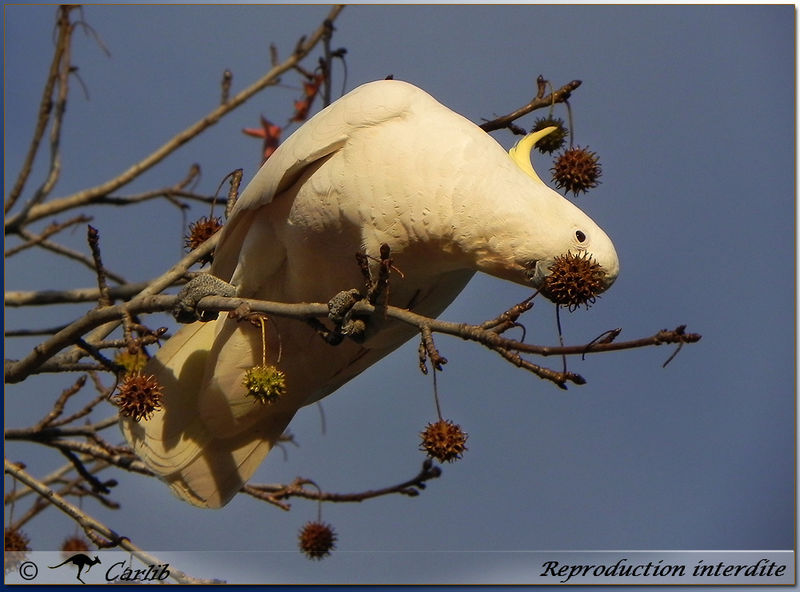
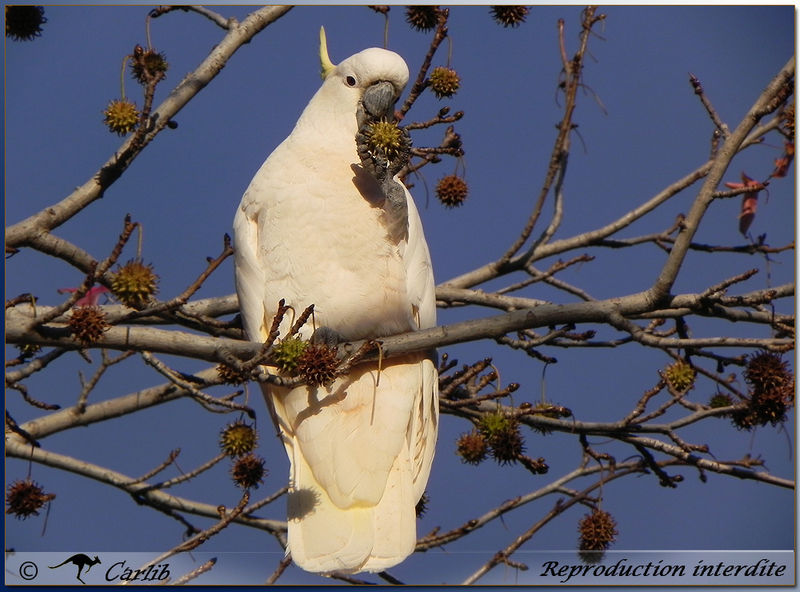
Tous les Cacatoès ont une particularité rigolote qui leur est bien spécifique: contrairement aux autres perroquets, le dessus de la tête n'a pas de plumes juste sous la crête, et l'effet assez curieux! Mais cela s'explique quand celle-ci est au repos et recouvre alors entièrement le dessus de la tête!
Le dimorphisme est quasi inexistant chez les Cacatoès dits "blancs", si ce n'est dans l'attitude plus douce des femelles (et leur iris, rouge à l'âge adulte) et plus machiste chez les mâles.... (Bizarre-bizarre!!!)
Mais voilà... pour les éleveurs, il faudrait attendre près de 4 ans pour le savoir! Donc pour s'assurer du sexe des jeunes, un vétérinaire peut procéder d'au moins deux façons. Pour les détails, voir dans la Page "Perroquets" à "Sexage", sous la bannière.
The Sulphur crested Cockatoo
Cockatoos have a funny peculiarity quite specific... Contrary to the other parrots, the top of their head has no feathers right under the crest... A rather curious effect! But it is explained when the crest is at rest and covers the top of the head! Dimorphism is almost non-existent with Cockatoos said "white" if not for the females' softer attitude and a chauvinist one for the male.... now, isn't that strange???!!! Only at adulthood, the iris of the female becomes brownish-red. But the breeders would have to wait about 4 years for this info! Thus to make sure what sex are the youngsters, a veterinarian can proceed in at least two ways. For details, see under the Page "Parrots", the "Sexing" section, under my banner.
Le ciel était assez chargé, et je redoutais la pluie!
20/06/2010
Le dimorphisme est quasi inexistant chez les Cacatoès dits "blancs", si ce n'est dans l'attitude plus douce des femelles (et leur iris, rouge à l'âge adulte) et plus machiste chez les mâles.... (Bizarre-bizarre!!!)
Mais voilà... pour les éleveurs, il faudrait attendre près de 4 ans pour le savoir! Donc pour s'assurer du sexe des jeunes, un vétérinaire peut procéder d'au moins deux façons. Pour les détails, voir dans la Page "Perroquets" à "Sexage", sous la bannière.
The Sulphur crested Cockatoo
Cockatoos have a funny peculiarity quite specific... Contrary to the other parrots, the top of their head has no feathers right under the crest... A rather curious effect! But it is explained when the crest is at rest and covers the top of the head! Dimorphism is almost non-existent with Cockatoos said "white" if not for the females' softer attitude and a chauvinist one for the male.... now, isn't that strange???!!! Only at adulthood, the iris of the female becomes brownish-red. But the breeders would have to wait about 4 years for this info! Thus to make sure what sex are the youngsters, a veterinarian can proceed in at least two ways. For details, see under the Page "Parrots", the "Sexing" section, under my banner.
Le ciel était assez chargé, et je redoutais la pluie!
20/06/2010

L'habitat de ce Cacatoès est assez vaste et couvre une très large bande est de l'Australie, de la péninsule de York à la Tasmanie. Il est probable, d'après Joseph M. Forshaw, l'auteur de "Parrots of the World", que ce soit cette espèce qui ait été introduite en Nouvelle Zélande.
The Sulphur crested is widely spread on a large band along the eastern side of Australia, from the Cape York peninsula to Tasmania. According to Joseph M. Forshaw in "The Parrots of the World", this is probably the species introduced into New Zealand.

Ce mâle crie à tue-tête pour attirer une femelle....
This guy is shouting like crazy to attract a female,

...et la voilà!!!...and low and behold, here she comes!